
Can you actually live in the Mallorcan countryside, the foravila?
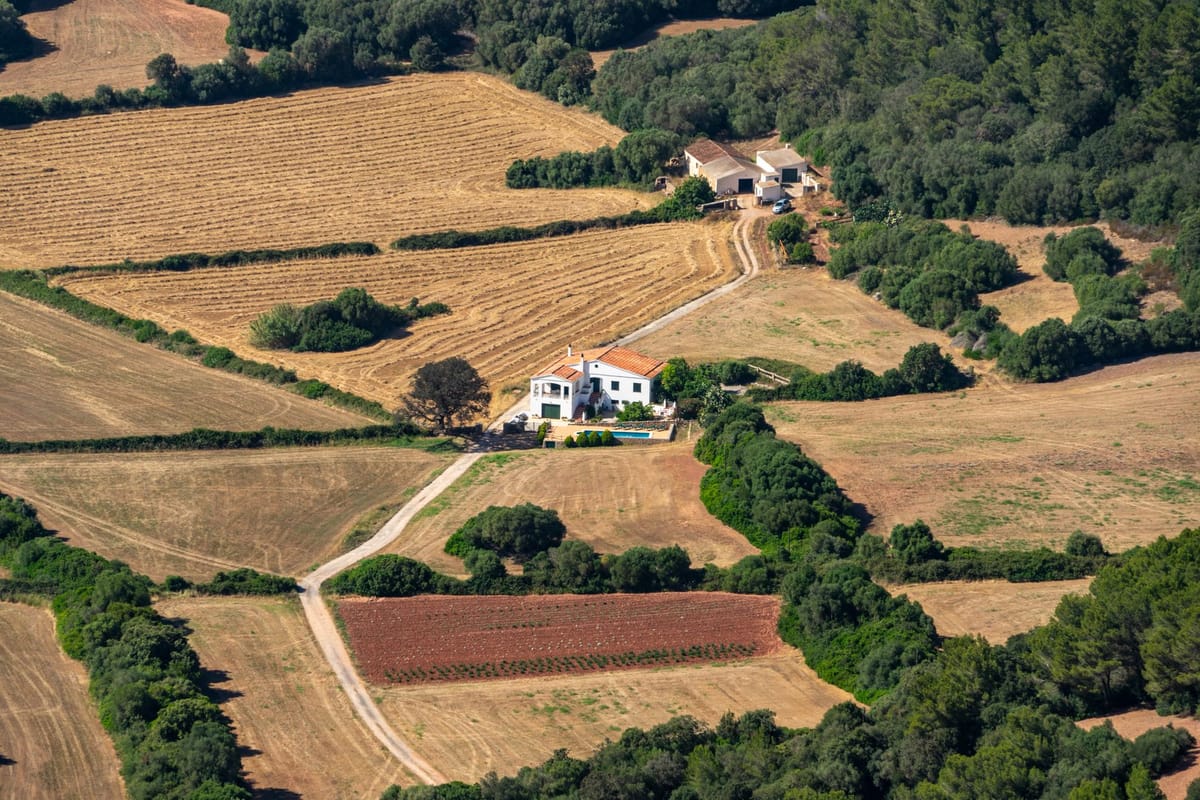
Yes, you can live in the foravila, Mallorca's cultivated countryside, but building there is tightly regulated: on sol rustico (non-developable rural land), the regional planning law (Ley 12/2017, known as the LUIB) and the protected-spaces law (Ley 1/1991) ban construction in ANEI, wooded ARIP and AANP protected zones, and elsewhere require a minimum single plot of 14,000 or 50,000 square metres in Mallorca depending on the land category. In practice, most people live in an existing finca or possessio rather than something newly built, and prices are climbing fast, driven by foreign buyers.
What exactly is the foravila and sol rustico?
Foravila is the Mallorcan name for cultivated countryside outside the villages, what Castilian Spanish calls the campo. Living there is legal, but any construction depends on the sol rustico category of the plot and the island's Plan Territorial, a competence of each Consell insular. Rural land in the Balearics is also Spain's top property market for non-residents: 38 percent of homes sold between 2007 and 2025 went to foreign buyers, according to Consejo General del Notariado data published in December 2025.
| Reference point | Detail | Source |
|---|---|---|
| Balearic planning law | Ley 12/2017 (LUIB), sol rustico | BOE, Ley 12/2017 |
| Protected-spaces law | Ley 1/1991 (ANEI, ARIP, AANP) | BOE, Ley 1/1991 |
| Dwellings per rural plot | One only (article 25 LUIB) | Ley 12/2017 |
| Minimum plot in Mallorca | 14,000 or 50,000 sqm depending on land type | Plan Territorial de Mallorca |
| Purchases by foreigners | 38 percent of sales (2007-2025) | Consejo General del Notariado, Dec 2025 |
What does foravila mean, and what is a possessio?
Foravila (or fora vila, literally "outside the town") is Mallorcan Catalan for the inhabited, cultivated farmland: the countryside, the finca, the mas, according to the RodaMots dictionary and the newspaper Ara Balears. Someone who lives and works there is a foraviler. At island scale, people also speak of the Part Forana: all of Mallorca outside Palma (the old Ciutat), meaning every inland village, as opposed to the capital.
At the heart of this landscape sit the possessions: large rural estates, unique to Mallorca, combining a manor house with farm buildings at the centre of vast land holdings. The term dates back to the 16th century, with equivalents in the Catalan mas or the Andalusian cortijo, according to the Spanish-language Wikipedia. A possessio was organised around a strict hierarchy: the amo, a manager who paid an annual rent to the owner and ran production, the madona, his wife who ran the household, and the missatges, permanent farmhands. Figs and grain dried on the top floor, called es sostre, where day labourers also slept. That rural way of life still runs through the Serra de Tramuntana and its attachment to Balearic land. Today, a finca can mean anything from a small plot to a multi-hectare estate for sale.
What does the Balearic planning law (LUIB) say?
The rules are set by Ley 12/2017, of 29 December, on urban planning in the Balearic Islands (the LUIB), published in the BOE in early 2018 and complemented by Ley 1/1991 on natural spaces. Sol rustico is non-developable land: you cannot build there the way you would in town. The LUIB only allows a single detached, single-family dwelling per rural plot (article 25), and bans turning it into a multi-unit building or multiplying outbuildings.
A key Balearic point: land-use planning falls to the Consells insulars, not just the regional Govern. Mallorca, Menorca, Ibiza and Formentera each have their own Consell and Plan Territorial Insular, which sets land categories and minimum surface areas. The thresholds cited here apply to Mallorca's Plan Territorial; Menorca, a biosphere reserve, and the Pityusic Islands (Ibiza, Formentera) apply their own rules, often at least as strict. Before any purchase, the exact category of a plot should be checked with the town hall and the relevant Consell.
ANEI, ARIP, AANP: where is building banned?
Ley 1/1991 created the main categories of protected sol rustico that determine whether land is buildable. In AANP zones (highest level of protection: parks, reserves, natural monuments) and in ANEI zones (areas of special natural interest), building a detached home is effectively banned. Wooded ARIP zones (ARIP-B) and territorial protection areas are also excluded. What remains buildable, under strict conditions, is ordinary ARIP land, agricultural interest areas (AIA) and general-regime sol rustico (SRG), according to architecture firm Slow Studio, which details the rules of Mallorca's Plan Territorial.
| Sol rustico category | Can you build? | Use |
|---|---|---|
| AANP (highest protection) | No | Parks, reserves, natural monuments |
| ANEI (special natural interest) | No, detached home banned | High-value natural spaces |
| Wooded ARIP (ARIP-B) | No | Wooded rural areas of scenic interest |
| Ordinary ARIP | Yes, minimum 50,000 sqm plot | Rural landscape, agriculture |
| Forest SRG (SRG-F) | Yes, minimum 50,000 sqm plot | Forest, general use |
| AIA (agricultural interest) | Yes, minimum 14,000 sqm plot | Farmland |
| SRG / transition (AT-H) | Yes, minimum 14,000 sqm plot | Ordinary rural land |
What is the minimum plot size to build in the foravila?
In Mallorca, to build a single-family home on buildable land, the plot must reach 14,000 square metres (1.4 hectares) in an agricultural interest area, a transition zone or the general regime, and 50,000 square metres (5 hectares) in ordinary ARIP or forest regime, according to Slow Studio and Mallorca's Plan Territorial. Date conditions also apply: the plot generally has to have been subdivided before 16 July 1997, otherwise buildability is heavily restricted. And as noted, only one dwelling is allowed per plot.
These thresholds are themselves under pressure. Facing speculation and an influx of foreign investors, the Consell de Mallorca has studied raising the minimum plot from 14,000 square metres to a range of 21,000 to 28,000 square metres, according to Slow Studio, to slow the fragmentation of the landscape. The debate remains open, but it illustrates a broader trend: in the foravila, rules are tightening rather than loosening.
Can you legalise an existing house? The 2024 amnesty
Yes, partly, and this is the notable development. Decreto ley 3/2024, of 24 May, opened an "extraordinary legalisation" procedure in the Balearics for buildings on sol rustico that were fora d'ordenacio (non-compliant), popularly known as an "urban planning amnesty", according to law firms PwC and DiG Abogados. For three years from its entry into force, an owner can legalise a building erected without a permit or against the zoning plan, provided the deadline to demand its demolition has already expired.
The trade-off is clear: a regularised property cannot be used for tourist rental, the text specifies. This amnesty does not turn a ruin into a rental villa, but it does give legal security to existing country homes, which, combined with the scarcity of buildable rural land, keeps pushing prices up.
Why are finca prices climbing?
Because foreign demand is now concentrated on the rural interior. The Balearics lead the Spanish market for purchases by non-residents (38 percent of sales 2007-2025, Consejo General del Notariado, December 2025), and in Mallorca German buyers alone account for close to 44 percent of foreign transactions, according to Ultima Hora (January 2025). The result: possessions and inland fincas, long neglected, have become luxury products. The price per square metre exceeds 4,400 euros in Palma in early 2025, sits around 2,700 euros in the island's centre (Selva, Felanitx) and climbs above 5,000 euros to the east, near the Tramuntana, according to local agencies. In 2024, the number of transactions fell 15 to 20 percent, but prices kept rising 8 to 12 percent.
Faced with a housing crisis for residents, the question of a ban on purchases by foreigners returns to the Balearic Parliament every year. Govern president Marga Prohens (PP) has ruled it out in the name of free capital movement within the EU, while the Balearic left has filed, unsuccessfully, restriction proposals, according to eldiario.es and Menorca.info (December 2025). Meanwhile, the origin and value of what this land produces is also debated on the plate: we cover that in our investigation into food labelling and origin in the Balearics.
Frequently asked questions
Can you live year-round in the foravila?
Yes. Residing on sol rustico is legal if the dwelling is properly registered. The difficulty is not living there, it is building something new, which is heavily regulated, or setting up a tourist activity, which needs a separate authorisation.
Can you build a new house on a protected plot?
In principle no in the AANP, ANEI and wooded ARIP categories, where a detached dwelling is banned. Elsewhere, only if the plot reaches the minimum surface area (14,000 or 50,000 square metres in Mallorca) and meets the conditions of the island's Plan Territorial.
What is a possessio?
It is a traditional large rural estate in Mallorca, combining a manor house and farm buildings at the centre of vast land holdings. Many are now restored and sold as prestige fincas.
Does the 2024 amnesty let you legalise anything?
No. Decreto ley 3/2024 only covers buildings whose demolition can no longer be legally demanded, for three years, and expressly bans turning them into tourist rentals. Every case needs to be checked individually.
Sol rustico rules evolve quickly, island by island: before any purchase or building project, confirm the plot's category with the town hall and the relevant Consell insular. Information verified in August 2026. The Daily Baleares is an AI-assisted publication with human review.
Le Livre blanc 2026 de l'expat
NIE, empadronamiento, fiscalité, école, logement : tout l'essentiel pour s'installer, réuni dans un guide PDF. Laisse ton e-mail, on te l'envoie.
🎉 Et voilà ! Ton Livre blanc 2026 de l'expat s'ouvre ici :
Ouvrir le Livre blanc 2026Dernière étape pour rejoindre l'aventure : confirme ton inscription dans l'e-mail qu'on vient de t'envoyer.
Réagis à cet article