
How does Balearic humidity affect your health and your home?
Yes, humidity is a real issue in the Balearics: average annual relative humidity runs around 71 to 72 percent depending on the island, with winter peaks up to 79 percent in Palma (source: AEMET, 1981-2010 averages). This is not a minor comfort detail: above 60 percent humidity indoors, mould and dust mites take hold, and old coastal buildings suffer rising damp and salt corrosion. The good news is that most problems can be prevented with ventilation, the right materials and, if needed, costed solutions starting from around a hundred euros. Here is the full picture.
Is the air really more humid in the Balearics than elsewhere?
The archipelago has an island Mediterranean climate: surrounded by water, it never experiences the dry air of inland regions. According to AEMET's climate averages (1981-2010), average annual relative humidity reaches 72 percent in both Palma de Mallorca and Menorca, and 71 percent in Ibiza. The season changes everything: winter is the most humid (79 percent in January, November and December in Palma), summer the driest (62 percent in July in Palma, 63 percent in Menorca, 67 percent in Ibiza). In other words, humidity does not feel the same in August, when heat dries out the surrounding air, as it does in December, when it saturates the walls.
Wind plays a major role, especially in Menorca. The tramuntana, a cold, dry northerly wind, blows at over 5 m/s roughly 105 days a year on the island (source: menorca.org). After several days of strong tramuntana, the sky clears and humidity drops sharply. Conversely, the llevant (easterly wind) in spring and autumn, and the xaloc (south-easterly wind carrying warm African air) in summer, bring humidity back up. Knowing your area's prevailing wind helps explain why a room "sweats" some days and not others.
| Island (station) | Average annual humidity | Winter peak | Summer low |
|---|---|---|---|
| Mallorca (Palma, airport) | 72% | 79% (Jan, Nov, Dec) | 62% (July) |
| Menorca (airport) | 72% | 77% (Jan, Dec) | 63% (July) |
| Ibiza (airport) | 71% | 75% (January) | 67% (June-July) |
Source: AEMET, standard climate normals 1981-2010. Formentera has no separate official series published.
Why do old buildings suffer so much from humidity?
The problem is not just the air: it is the meeting of humid air with a porous building. In historic centres and Mallorcan village houses, walls were often built with no damp course or horizontal waterproof barrier. The result: groundwater rises by capillary action through materials that soak it up readily, such as mares (local sandstone), lime and traditional mortar. The symptoms are easy to spot: dark stains near the base of walls (especially in winter), whitish salt efflorescence, rotting wood, rusting metal (source: Constructec.es).
A classic renovation mistake: patching over lime with cement. Cement is waterproof, so it stops the wall "breathing": instead of evaporating, the damp rises higher and causes the mares to flake and crumble at the surface (source: Constructec.es). On an old coastal Mediterranean building, lime-based renders that let the wall release its moisture are the better choice. If you are buying or renting a period property in old stone near the sea, it is worth checking before signing.
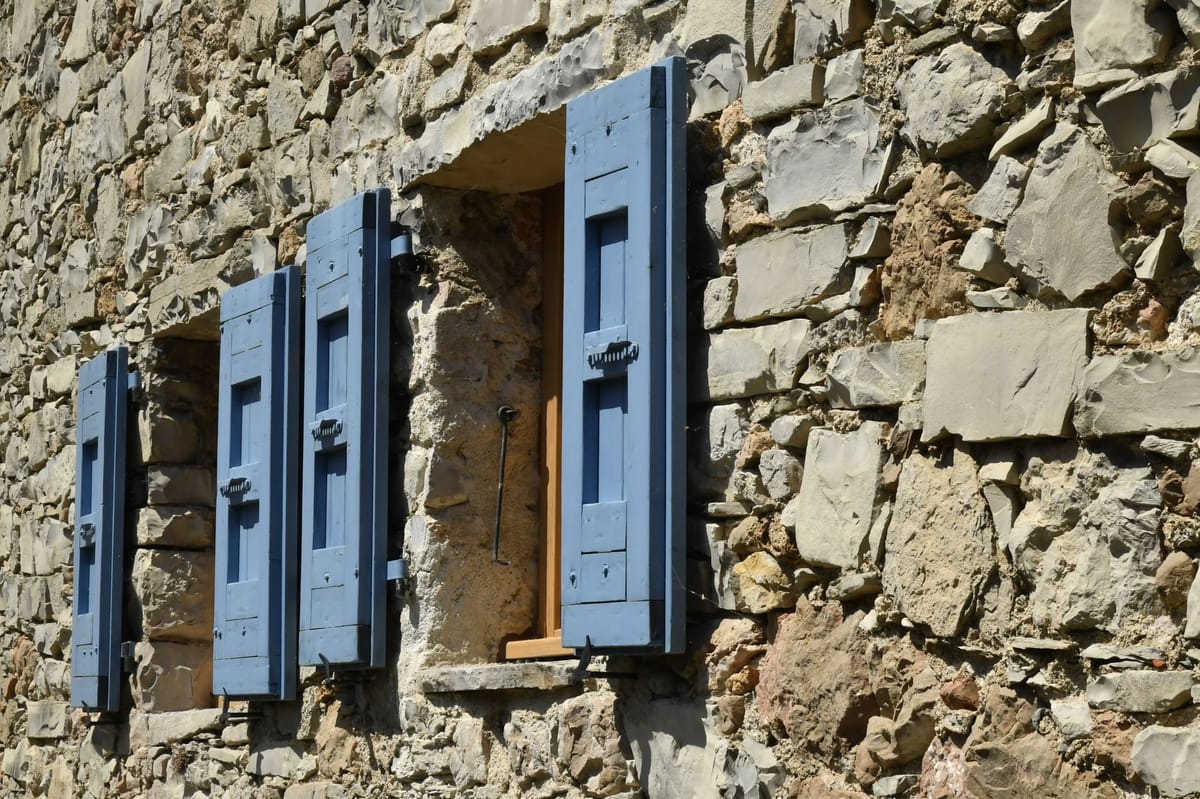
Sea proximity adds another enemy: salt. Chlorides speed up metal corrosion, and the combination of salinity, sun and the Mediterranean's wet-dry cycles wears everything out faster (sources: gscerrajeros.es, persianastosa.com). In practice, on the first line of the coast, poorly coated aluminium shutters corrode, and stainless-steel A4 screws and fittings are recommended. A small detail that saves you from redoing everything after three winters.
How much does treating humidity cost?
It depends entirely on the type of humidity. The prices below reflect the general Spanish market (no Balearic-specific pricing was found: expect to pay somewhat more on the islands, as is often the case). For occasional condensation issues, a home dehumidifier starts around 109 euros, with serious 10 to 25 litre models (such as Meaco) priced between 254 and 320 euros (source: Xataka, 2026 selection).
For a more structural treatment, typical price ranges are as follows:
- Condensation, basic treatment (anti-damp paint plus ventilation): 250 to 700 euros per 12-15 sqm room.
- Mechanical anti-condensation system (automatic vents, MVHR): 900 to 1,500 euros.
- Fixed professional dehumidifier with sensors: 1,200 to 1,600 euros, installation included.
- Rising damp (chemical injections into the wall): 70 to 110 euros per linear metre, roughly 1,400 to 2,200 euros for a typical house of around 20 linear metres.
Price sources: Xataka (2026) and Wollyhome.com (2026 price guide). Before committing to injections, get the diagnosis confirmed: what looks like "rising damp" is sometimes simple condensation, which is far cheaper to fix.
What are the health effects of humidity?
The evidence is solid. The WHO Housing and Health Guidelines (WHO-CED-PHE-18.10) note there is epidemiological evidence that living in a very humid environment increases the risk of respiratory illness, allergies and asthma. Across the EU, the WHO estimates 20 to 30 percent of homes present a health risk linked to damp and mould (source: who.int). This is not a marginal issue, nor one specific to the Balearics.
The most commonly cited recommendation for a healthy indoor environment: keep relative humidity between 40 and 60 percent. Above 60 percent, mould and dust mites thrive (a common recommendation rather than a single official standard). The measures that work are simple and free: air the home for ten minutes morning and evening even in winter, avoid drying laundry in a closed room, ventilate the bathroom after a shower, and watch cold wall corners where air stagnates. A cheap hygrometer will tell you where you stand.
Is there help available to renovate a damp home?
Yes, but rarely labelled "humidity" as such: it usually comes through renovation or energy-efficiency schemes. In the Balearics, IBAVI (Institut Balear de l'Habitatge) manages housing aid, including renovation programmes co-financed by EU Next Generation funds. Treating humidity often forms part of a broader project (insulation, ventilation) eligible for these schemes. Amounts and timelines change from one call for applications to the next: check current conditions before starting.
Some town halls also open their own schemes. As a dated example, Calvia offered renovation grants for buildings and homes, with applications open from 29 December 2025 to 29 January 2026 (source: calvia.com). So check both the regional level (IBAVI) and your town hall. And if you have just arrived on the islands, our guide to moving to the Balearics: the first 90 days can help you navigate the paperwork. For the health side, we cover how the Spanish healthcare system works if a respiratory issue sends you to a doctor.
Frequently asked questions
Which is the most humid island in the Balearics?
On annual average, Mallorca and Menorca are neck and neck (72 percent at the airport station, against 71 percent in Ibiza, according to AEMET). The gap shows mostly in winter: Palma reaches 79 percent in January, just above Menorca (77 percent) and Ibiza (75 percent). Ibiza stays the driest in summer.
What humidity level should you aim for indoors?
The generally recommended range is 40 to 60 percent relative indoor humidity. Below that, the air feels uncomfortably dry; above 60 percent, mould and dust mites develop. A cheap hygrometer is enough to keep track.
Do you need a dehumidifier in the Balearics?
Not necessarily. In a well-ventilated home, regular airing is often enough. A dehumidifier (from 109 euros, roughly 254 to 320 euros for a good 10-25 litre model) is useful in winter in a room that condenses, or to dry out an old ground-floor home.
Why do my shutters and fittings rust so fast near the sea?
Because of salt: marine chlorides speed up metal oxidation, especially combined with wet-dry cycles and Mediterranean sun. On the first line of the coast, well-coated aluminium and A4 stainless-steel screws hold up far better against salt corrosion.
Is cement a good fix for a damp old wall?
No, it is often the mistake to avoid. On an old wall made of mares or lime, waterproof cement stops the wall breathing: the damp rises higher and causes the stone to crumble. Lime-based renders, which let moisture escape, suit the islands' traditional buildings better.
Sources: AEMET (1981-2010 climate averages); menorca.org (wind patterns, tramuntana); Constructec.es (old buildings, rising damp, lime and cement); gscerrajeros.es and persianastosa.com (salt corrosion, A4 stainless steel); Xataka (dehumidifiers, 2026 selection); Wollyhome.com (2026 price guide); World Health Organization, Housing and Health Guidelines WHO-CED-PHE-18.10 (who.int); IBAVI (Institut Balear de l'Habitatge); calvia.com (municipal grants).
Information verified in August 2026. The Daily Baleares is an AI-assisted publication with human review.
Le Livre blanc 2026 de l'expat
NIE, empadronamiento, fiscalité, école, logement : tout l'essentiel pour s'installer, réuni dans un guide PDF. Laisse ton e-mail, on te l'envoie.
🎉 Et voilà ! Ton Livre blanc 2026 de l'expat s'ouvre ici :
Ouvrir le Livre blanc 2026Dernière étape pour rejoindre l'aventure : confirme ton inscription dans l'e-mail qu'on vient de t'envoyer.
Réagis à cet article