
Raising children far from family in the Balearics: the mental load of expat mothers
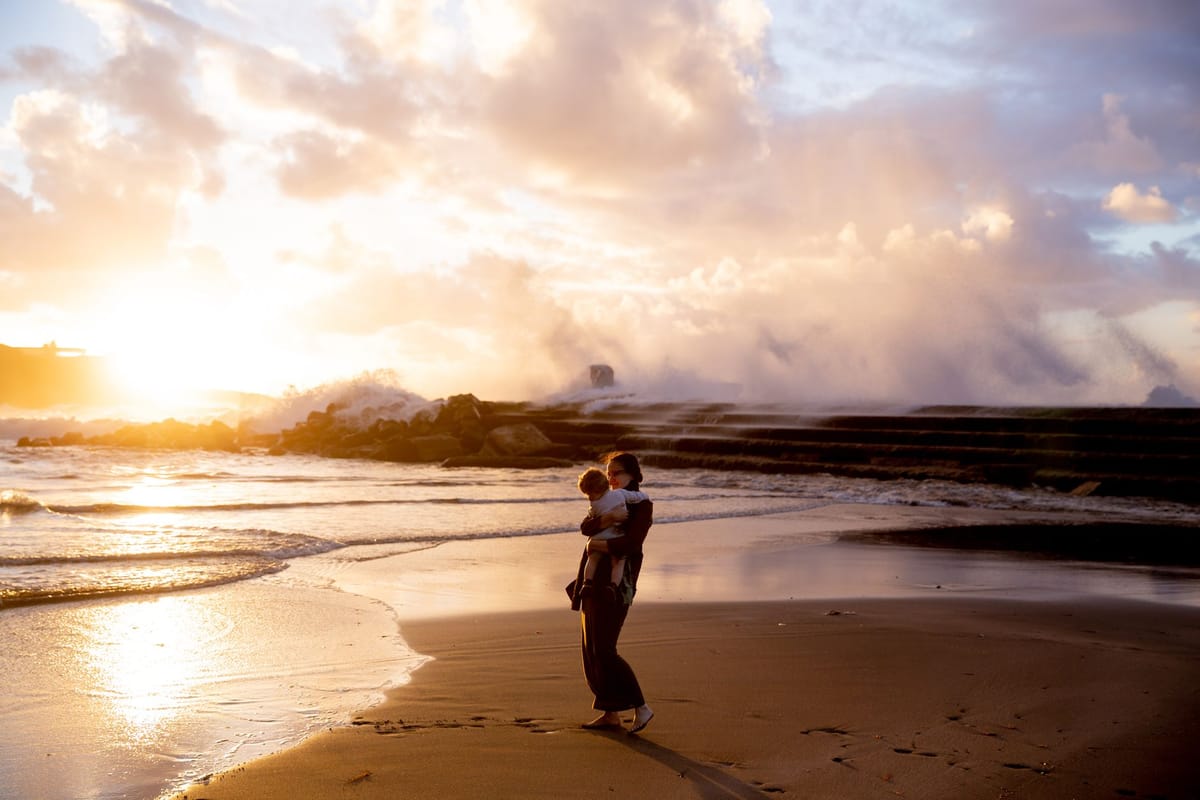
Yes, raising your children far from your own mother is a real mental load, not a personal weakness, and the Balearics' insularity sharpens it: between you and your family lies the sea, the cost of a ticket, and a whole logistics of back-and-forth trips no train will ever simplify. But you are not alone on these islands, and real support exists, from free early-years childcare to networks of mothers who came from elsewhere. Here, without overdramatising, is what building a family on an archipelago genuinely changes.
Why does raising children far from family weigh so much?
Because mental load is not tired arms, it is a tired mind: anticipating, planning, carrying alone the thread of a thousand details no one else holds for you. A grandmother nearby is not just a free pair of hands on a Wednesday afternoon. She is an emotional safety net, someone who knows your children, to whom you can voice a worry at 10pm without apologising. When she lives a thousand kilometres and a sea crossing away, that net disappears, and everything falls back on the couple, or on you. This is not ingratitude towards the country you chose: it is the quiet grief of a handing-down that was meant to happen generation to generation, and now has to travel through a screen.
How does island life change the equation?
Because here, you do not "pop round" to see your mother on a Sunday. The sea means a ferry or a flight, never a car, never a train, and that water barrier turns a spontaneous visit into a small project. The Balearics are among the Spanish regions with the highest share of foreign-born residents, around 27.65 percent according to national statistics (reported by local press, August 2025): in other words, a huge number of families here raise their children with no grandparent within a sea border. You are neither an exception nor an isolated case. Geography simply adds a layer of logistics to an already demanding situation, and that layer has a name: the crossing.
What does it really cost to fly grandparents over?
More time and money than a simple return train journey would suggest. By ferry, the Valencia-Palma route run by Balearia takes 7 to 9 hours, runs overnight, and starts around 99 euros return per passenger without a vehicle; the Barcelona-Palma link starts lower, from around 59 euros, but still means a 7 to 8 hour crossing on a conventional ferry. Flying is faster, but for grandparents coming to help for a few weeks, in peak tourist season, the bill climbs. The result: visits get planned well ahead, outside school holidays, and become rarer. Every visit becomes precious, and a little loaded with expectation, which does not always help everyone relax.
Does the high cost of living in the Balearics add to the load?
Yes, and it is a factor often underestimated. The Balearics closed 2025 as the most expensive Spanish region for housing, with an average sale price close to 2,994 euros per square metre. On rentals, the region is among the priciest in the country, around 19 euros per square metre a month according to idealista data, with Palma ranking among the most expensive capitals. In practice, that means smaller homes, often with no spare room for grandma to stay, and an already tight budget that leaves little room to pay for regular childcare. At the same time, the Balearic fertility rate has fallen to 1.05 children per woman in 2024, against 1.33 in 2008, a sign of a context where having children takes ever more organisation.
What real support exists when family is far away?
Plenty, and that is the good news in this article. Since the 2023-2024 school year, the Balearic Government has made the first early-years education cycle free, the escoleta for ages 0 to 3: more than 14,140 places were operating in 2025-2026, open to every family with no income condition, on a basis of at least four hours of schooling a day, from September to June, meals not included. On top of that, there are AMPA parent associations, cangurs and babysitters, and above all a fabric of mothers' networks. Many international communities organise WhatsApp groups by neighbourhood and by child's age, where prams get lent out, a hand is offered for a medical appointment, and reassurance is shared. Rebuilding a circle takes time, as we cover in our piece on friendship after 35 as an expat, but that circle ends up playing, in part, the role of the absent family.
| Island challenge | Possible support |
|---|---|
| No grandparents nearby for a helping hand | Free escoleta for ages 0-3, a universal place with no income condition |
| Feeling isolated in the first months | Expat mothers' networks, neighbourhood groups |
| Flying family over is expensive and slow | Book ferry or flight tickets ahead outside season, share costs with other families |
| No backup for evenings or the unexpected | Babysitting, school AMPA, neighbours from local village fetes |
| Passing on language and the sense of "home" | Schools, associations, language classes and regular video calls with grandma |
Palma, Menorca, Ibiza, Formentera: is it the same everywhere?
No, and the gap between islands is real. Palma remains the best resourced: an international airport, direct ferries to Valencia and Barcelona, and the widest range of escoletes, private nurseries and networks in the archipelago. At the other end, Formentera has no airport at all: it is reached only by sea, always via Ibiza, with a 25 to 35 minute ferry crossing. Flying parents over there means one more connection, and childcare places are inevitably scarcer. Menorca and Ibiza sit in between, very well connected in summer, more isolated in winter.
| Island | What it changes for flying family over and finding childcare |
|---|---|
| Mallorca (Palma) | International airport and direct ferries; the widest range of childcare and networks |
| Menorca | Smaller airport, fewer direct flights off-season; a dense associative network but concentrated in Mao and Ciutadella |
| Ibiza (Eivissa) | Very well connected in summer, more isolated in winter; a large international community, pricier childcare in peak season |
| Formentera | No airport: always via Ibiza (25 to 35 min ferry); limited services and childcare places |
How can you lighten the everyday load?
By giving up on trying to replace, alone, an entire family. Three habits come up often among mothers settled here. First, ritualise the bond with grandma: a video call at a fixed time, bedtime stories shared over a screen, so distance does not sever the relationship. Second, lean without guilt on the support that exists, starting with the free escoleta and extra childcare when the budget allows. Third, build a local network early, since that is what gets you through an unexpected fever on a Tuesday. The load does not disappear, but it gets shared, and that is already huge.
Frequently asked questions
Can my child attend the escoleta for free from birth?
The first early-years education cycle, ages 0 to 3, has been free in public and network-affiliated centres since the 2023-2024 school year, with no income condition. Places stay limited and are applied for during enrolment windows set each spring: check early with the Conselleria d'Educacio.
Is it cheaper to fly my parents over by ferry or by plane?
It depends on the season and the number of people. The Valencia-Palma ferry starts around 99 euros return per passenger without a vehicle, but takes a full night; flying is faster and sometimes competitive off-season. Always compare while booking well ahead and avoiding school holidays.
How can you meet other mothers when you have just arrived?
Through escoleta and school parent groups, AMPAs, expat family associations, and international networks organised in neighbourhood messaging groups. Neighbourhood fetes and playgrounds are also, very practically, places to meet people.
Is it harder on the smaller islands?
Yes, logistically. Formentera, with no airport, forces every trip to the mainland through Ibiza, and childcare services there are scarcer than in Palma. Human connection, though, is often easier to build there, given how small the communities are.
Information verified in August 2026. The Daily Baleares is an AI-assisted publication with human review.
Le Livre blanc 2026 de l'expat
NIE, empadronamiento, fiscalité, école, logement : tout l'essentiel pour s'installer, réuni dans un guide PDF. Laisse ton e-mail, on te l'envoie.
🎉 Et voilà ! Ton Livre blanc 2026 de l'expat s'ouvre ici :
Ouvrir le Livre blanc 2026Dernière étape pour rejoindre l'aventure : confirme ton inscription dans l'e-mail qu'on vient de t'envoyer.
Réagis à cet article